Characters at a glance
The characters in Order of the Sinking Star determine how you solve its puzzles: each playable hero has abilities and restrictions that change what you can accomplish. Understanding those differences becomes especially useful when characters from separate worlds meet. The announced lineup includes royalty, fantasy adventurers, and a talking boat, with several roles performed by an established voice cast.
The table below brings together characters identified in the publisher's description and the main cast announcement. It is a reference to announced characters, rather than an exhaustive roster of everyone encountered during the story.
| Character | Voice actor | Established role or introduction |
|---|---|---|
| The Queen | Emily O'Brien | The character introduced at the beginning of the game |
| The Warrior | Liam O'Brien | One of the heroes named in the publisher's description |
| The Wizard | Darin De Paul | One of the heroes named in the publisher's description |
| The Bard | Anjali Bhimani | A named character in the main voice cast announcement |
| The Sailor | Erica Luttrell | A named character in the main voice cast announcement |
| The Druid | Matthew Waterson | A named character in the main voice cast announcement |
| The Thief | Not identified in the cast announcement | A hero included in the publisher's description |
| Talking boat | Not identified in the cast announcement | An unusual hero included in the publisher's description |
The Nintendo publisher description identifies the Queen, Thief, Warrior, Wizard, and talking boat as examples of the game's heroes. Their abilities complement one another as their journeys become connected.
Erica Luttrell's announced role is the Sailor. That credit does not establish that she voices the talking boat. Likewise, the additional performers listed later in this article should not be assigned to the Thief or other characters without an identified role.
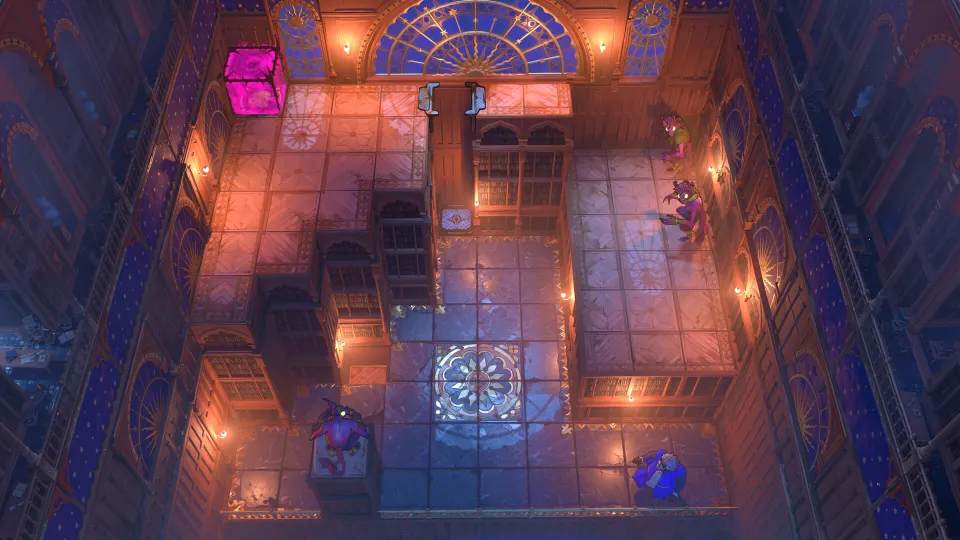
The Queen and the connected story
The Queen provides the player's introduction to the game's mysterious setting. She begins uncertain about her surroundings and searching for familiar people, giving the opening puzzles a narrative purpose beyond reaching an exit. Her confusion establishes questions that continue as exploration opens up.
After the introductory area, the game leads to a crossroads with four directions to explore. Progress introduces sequences involving other characters, each with particular abilities and limitations. Their connections to the Queen are not immediately explained, so meeting someone new does not necessarily resolve where they fit into the larger story.
Character development arrives alongside puzzle solving. Brief dialogue, recordings, and collectible notes reveal information as you discover routes and complete challenges. This makes exploration part of understanding the cast: the next useful detail may come from entering another region rather than finishing every puzzle along your current path.
As described in Noisy Pixel's review, characters' recurring behaviors also shape their personalities. Moving objects, collecting gems, throwing stones, and performing music are tied to how players experience their limitations. You learn about these figures by depending on what they can do and adjusting when their usual behavior complicates a solution.
Voice cast and additional performers
The main voice cast announcement identifies six character-to-actor pairings, listed above. It also names five additional performers without assigning each one a specific character. Jonathan Blow, the game's director, is included in a special unnamed role.
| Additional performer | Other work or involvement identified in the announcement |
|---|---|
| Erik Braa | League of Legends and Marvel Rivals |
| Andrew Kishino | Star Wars: The Clone Wars and Marvel Rivals |
| Jamieson K. Price | Persona 5 and Bleach |
| Sabrina Fest | Avatar Legends: The Fighting Game |
| Jonathan Blow | Director of Order of the Sinking Star, appearing in an unnamed role |
These credits come from the main voice cast announcement reported by Bleeding Cool.
How characters fit into the four worlds
The game introduces four puzzle traditions through separate worlds, each with its own characters and story. The early routes from the crossroads give players different rules to learn before those systems begin interacting. Understanding a region's mechanics helps explain what its characters contribute when they encounter unfamiliar situations.
| Early route | Main puzzle focus | What to pay attention to |
|---|---|---|
| North: fantasy hero puzzles | Characters with different movement and object-manipulation behaviors | Positioning and the particular actions each hero can perform |
| East: mirror puzzles | Exchanging places with reflections | Where reflections appear and which locations a swap makes accessible |
| West: gem and beam puzzles | Gems, light beams, and environmental manipulation | How changes to the environment affect possible actions |
| South: stone puzzles | Throwing stones to create routes through water | How the placement of stones changes where movement becomes possible |
These are useful starting distinctions, but they do not remain isolated categories. A mirror mechanic can later appear alongside the fantasy heroes, making previously learned character behaviors relevant in a different setting.
Mirrors illustrate how much a familiar action can expand. A single mirror allows a character to exchange places with a reflection. Multiple mirrors can produce multiple reflections and create copies that move together, turning an apparent travel tool into a coordination problem.
Music is another confirmed element of character-based puzzle solving. The official game account has highlighted music as a way to make progress while emphasizing that playable characters have distinct abilities. That establishes its puzzle relevance, although it is not a complete explanation of the Bard's rules.
Class names alone are therefore an incomplete guide. Learn the actual movement, interactions, and restrictions demonstrated by a character's puzzles before assuming what a Warrior, Wizard, or Druid should be able to do.
Working with different heroes
A character's restriction is often part of the puzzle's construction. The useful question is what their allowed actions make possible in the current arrangement. A hero who seems awkward in one room may provide exactly the interaction another room requires.
Use the introductory puzzles to build a practical understanding of each character:
- Check movement first. Notice where the character can stand, what blocks a route, and whether a special action changes which positions are reachable.
- Observe object interactions separately. Moving an object and moving around it are different problems. Learn the behavior demonstrated in that character's puzzles before planning several actions ahead.
- Account for repeated behavior. A recurring action or compulsion can affect the whole solution. Include it in your plan instead of treating it as incidental characterization.
- Reconsider familiar abilities when worlds meet. Mirrors, beams, stones, and another hero's actions can change the usefulness of something you already understand.
- Use undo to examine consequences. Most actions can be reversed, letting you compare arrangements without replaying the entire puzzle. Resetting is also available when you want a fresh starting point.
The open structure also lets you leave a difficult region and investigate another. You do not have to complete every puzzle in one direction before making progress elsewhere. Returning after working with different characters can give you another way to interpret a stalled situation.
FAQ
Is this a complete list of order of the sinking star characters?
The list covers characters named in the publisher's description and main voice cast announcement. The publisher presents several heroes as examples, so the eight entries should not be treated as the game's complete roster. Additional cast members also have roles that were unnamed in the announcement.
Who is the first character you control?
The game opens with the Queen, voiced by Emily O'Brien. Her introductory sequence establishes her uncertainty about the setting before exploration expands toward the crossroads and the four main puzzle directions.
Who voices the Warrior and Wizard?
Liam O'Brien voices the Warrior, and Darin De Paul voices the Wizard. Anjali Bhimani plays the Bard, Erica Luttrell plays the Sailor, and Matthew Waterson plays the Druid.
Who voices the Thief and talking boat?
The main cast announcement does not identify an actor for either character. Both appear among the heroes described by the publisher. The Sailor credit belongs to Erica Luttrell, but that should not be treated as a confirmed talking-boat credit.
Do all playable characters have different abilities?
The official description emphasizes distinct, complementary abilities. Characters also have limitations that matter during puzzle solving. As worlds merge, the interaction between those abilities and other regions' mechanics creates new possibilities.
Do you need to finish every character's puzzles to reach the ending?
You do not need to solve every puzzle to reach the story's conclusion. The nonlinear structure allows you to explore another world when a challenge becomes difficult and return later. However, that does not establish that every individual character's entire sequence is optional.